
What Happens If an ALTA Survey Reveals an Encroachment?
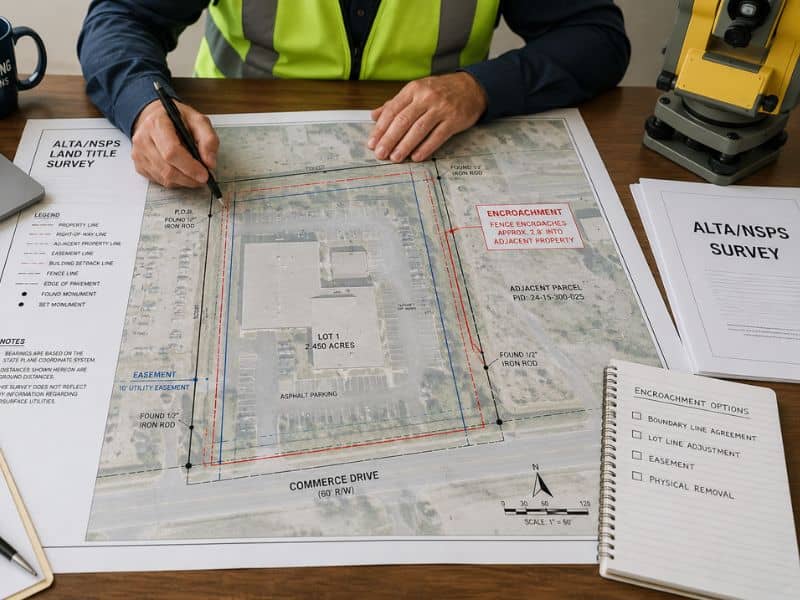
An ALTA survey provides a detailed look into a property’s physical and legal reality. When it uncovers an encroachment, buyers, sellers, lenders, and title companies must pause. What happens next determines whether a transaction closes, pauses, or falls apart.
Understanding Encroachments
An encroachment happens when a structure or improvement crosses a property line without legal authorization.
These issues are rarely visible during a standard title search. An ALTA survey catches them by combining physical boundary measurements with title record analysis.
Transactions face two distinct scenarios:
- Encroachments onto the property: A neighbor’s structure crosses into the land you are buying.
- Encroachments by the property: A structure on the land you are buying extends onto a neighbor’s parcel.
Both scenarios introduce legal risk, require disclosure to lenders and title companies, and demand a resolution before a commercial deal can move forward.
Typical Finds on a Survey Map
- Fences and walls: Older fences frequently straddle true property lines rather than sitting exactly on them.
- Building overhangs: Roof eaves and cornices can project past legal boundaries, especially on older downtown structures.
- Paved surfaces: Driveways and commercial parking lots often creep onto adjacent lots during past expansions.
- Equipment and utilities: HVAC units, generators, and retaining walls are occasionally installed without a prior boundary check.
Why Encroachments Disrupt Due Diligence
A boundary discrepancy is a financial risk that alters the value and marketability of real estate.
Lender Risk
Commercial lenders require ALTA surveys to protect their collateral. If a building they fund sits partially on a neighbor’s land, their security interest is compromised. A hostile neighbor could demand the removal of that structure, lowering the property’s value.
Title Insurance Limitations
Standard title insurance policies exclude matters that a correct survey would reveal. Once an ALTA survey flags an encroachment, the title company lists it as a specific exception. The insurer will not cover losses tied to that issue unless you resolve it or obtain a specific endorsement.
Future Sales
Unresolved issues stay with the land. The next buyer, lender, and title underwriter will encounter the exact same problem. Fixing it now protects long-term resale value.
Can the Transaction Close?
Yes. Many deals close despite survey issues, depending on severity and how the parties respond.
Minor issues—like a fence off by two inches—are often handled with a title policy endorsement. The insurer covers the risk, sometimes for an extra fee, provided the neighbor signs a basic acknowledgment.
Major issues involving permanent buildings require actual structural or legal fixes before a lender releases funds. If a neighbor already disputes the boundary, you must renegotiate the price, extend due diligence, or walk away.
How Title Underwriters Handle the Risk
Once a surveyor notes an intrusion, the title underwriting team reviews the legal risk to decide if the policy can move forward.
The initial title commitment lists the issue as an exception, removing coverage for any claims related to that specific boundary problem. From there, underwriters generally choose one of three paths:
| Path | Action | Best Used For |
| Exception Without Coverage | The insurer lists the issue but provides zero protection if a dispute occurs. | Minor issues accepted by low-risk buyers or lenders. |
| Affirmative Endorsement | The insurer covers potential losses, often requiring an acknowledgment letter from the neighbor. | Low-risk, non-structural intrusions. |
| Requirement for Resolution | The insurer demands a formal fix before issuing the final policy. | Structural issues or large boundary overlaps. |
Methods for Resolution
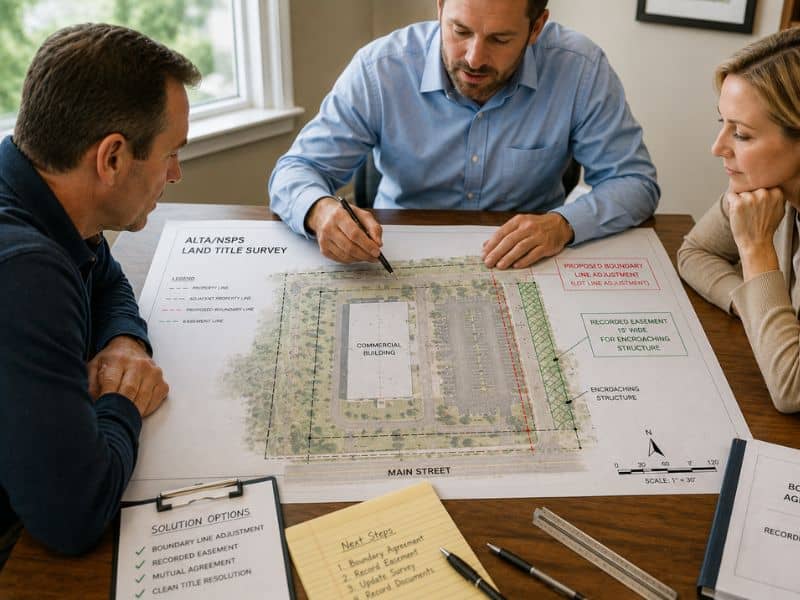
Fixes range from simple paperwork to structural modifications.
Boundary Line Agreements
Both owners sign a written agreement adjusting the line to match physical reality. Recording this document in public land records provides a clean solution for minor mismatches.
Lot Line Adjustments
A formal process that permanently relocates the legal boundary. It requires municipal approval, a new survey, and updated legal descriptions. It takes time but fixes the title cleanly.
Easements
The neighbor grants a recorded easement allowing the structure to remain. Ownership stays the same, but the property gains the legal right to keep the structure there. Title companies routinely insure over issues once a valid easement is recorded.
Physical Removal
Sometimes the simplest solution is moving the obstacle. Tearing down an old fence or moving a utility pad resolves the issue instantly, though this is rarely feasible for primary buildings.
Real-World Scenarios
- The Misplaced Fence: An ALTA survey showed a retail center’s rear fence sat three feet inside the neighboring lot. The seller recorded a boundary agreement with the neighbor. Closing shifted by three weeks, but the deal survived intact.
- The Encroaching Warehouse: A warehouse loading dock extended onto an adjacent industrial parcel. Because the seller owned both lots, they completed a lot line relocation before closing, satisfying the lender’s requirements.
- The Airspace Easement: A historic downtown building’s roof cornice extended 14 inches over the property line. Since removal was impossible, the seller secured an airspace easement from the neighbor, allowing the title company to issue an endorsement.
- The Hostile Neighbor: A buyer discovered an office park’s main driveway sat eight feet inside the neighboring parcel without an easement. The neighbor refused to negotiate or grant access. Lacking legal entry, the buyer canceled the contract.
Common Questions
Who pays to fix the issue?
This is a matter for contract negotiation. Sellers generally must deliver clean title, making resolution their responsibility before closing. Buyers occasionally accept the risk themselves in exchange for a price reduction.
How long do these resolutions take?
An acknowledgment letter or simple agreement takes days. Structural removals, formal lot line adjustments, or disputes with difficult neighbors can drag on for months.
Is an encroachment identical to an easement?
No. An easement is a legal right to use someone else’s land. An encroachment is an unauthorized physical intrusion. You often resolve an encroachment by turning it into an easement.
