
What’s New in the 2026 ALTA/NSPS Standards?
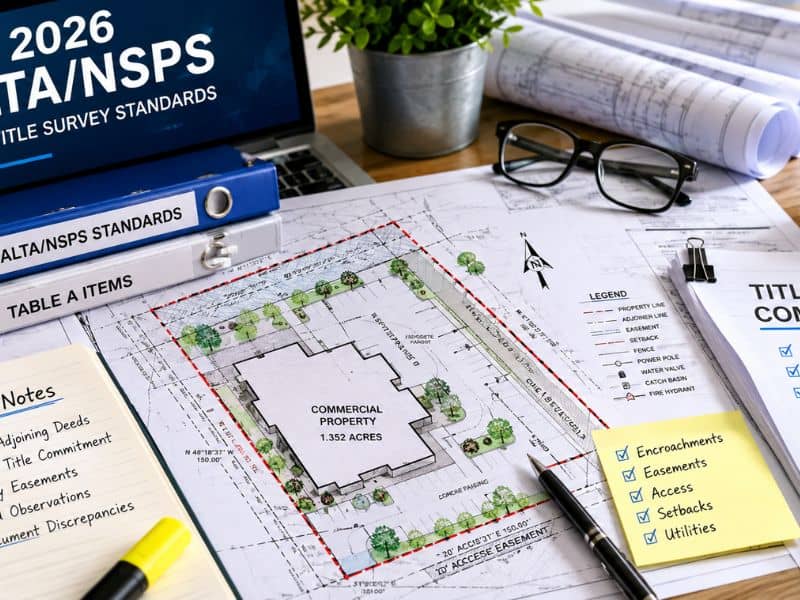
The 2026 Minimum Standard Detail Requirements for ALTA/NSPS Land Title Surveys took effect on February 23, 2026. Any survey contracted on or after that date must follow the new rules. Prior versions no longer apply.
This isn’t a reinvention. Most transactions won’t see a meaningful change in scope, cost, or timeline. What did change is how much surveyors must document, how encroachments and access conditions get reported, and who is responsible for gathering which documents.
If you’re a buyer, lender, developer, or attorney working on commercial real estate deals, these updates affect you. Some of the changes are subtle. A few are not.
Why the 2026 ALTA/NSPS Standards Were Updated
The Five-Year Review Cycle
ALTA/NSPS standards get reviewed every five years. A joint committee of ALTA and NSPS members meets, looks at how the current version is working in practice, and makes changes where the language is unclear or the responsibilities are misaligned.
This cycle has produced updated editions in 1999, 2005, 2011, 2016, 2021, and now 2026.
What Needed Fixing
The 2021 standards worked. But after five years of real transactions, a few problems kept coming up.
Some language was vague enough that surveyors and title professionals interpreted it differently. Responsibility for gathering certain documents wasn’t clearly assigned. And encroachment findings were being communicated inconsistently. One surveyor would flag an issue prominently. Another would tuck it into the drawing with no explanation.
The 2026 revision focused on three things:
- Cleaner language that leaves less room for interpretation
- Clearly defined responsibilities between surveyors, title companies, and clients
- Consistent reporting on encroachments and access conditions
New Documentation and Reporting Requirements Surveyors Must Follow
Surveyors Now Carry More of the Research Load
Under the 2021 standards, clients or title insurers were expected to provide deeds for adjoining properties. That’s no longer the case. Surveyors must now obtain those records on their own, typically through desktop research at local registries.
The title commitment requirement is also now stated directly, not implied. The surveyor must receive a copy of the most recent title commitment, or equivalent title evidence, before completing the survey. This matters because surveys completed without full title information have caused problems at closing. The 2026 standards close that gap.
Discrepancies Must Be Explained on the Survey
When field conditions don’t match what’s in the record, the surveyor must explain why, in writing, on the face of the survey. That applies to:
- Differences between recorded and measured distances
- Reasons a new legal description was prepared
- Limitations on access to the property
- Statements made by landowners or occupants about title or boundary issues
- Any observations that could change how the survey is interpreted
That last item deserves attention. If a property owner says something during fieldwork that touches on a boundary or access question, it now has to go in the survey. That information reaches the title insurer and the buyer. It doesn’t disappear after the field visit.
Easements Need a Full Accounting
Every easement listed in the title commitment must be addressed on the survey. The surveyor must state whether each one is:
- Shown on the survey
- Unable to be located in the field
- A blanket easement with no specific location
- Illegible in the recorded document
- Not applicable to the subject property
If the surveyor finds a recorded easement that isn’t in the title materials, they must notify the title insurer. The insurer decides whether it’s still active and whether it needs to be plotted. The 2026 standards also clarify that easements can end through legal mechanisms other than a recorded release. That’s how title chains work in practice, and the standards now reflect it.
Certifications Can Follow the Loan
Survey certifications can now be extended to a lender’s successors and assigns, when that language is requested. For lenders who sell loans on the secondary market, this removes the need to get corrected certifications after a transfer. It’s a small fix that saves real time.
How Encroachments and Access Issues Are Addressed Under the 2026 Standards
The Old Approach Had a Real Problem
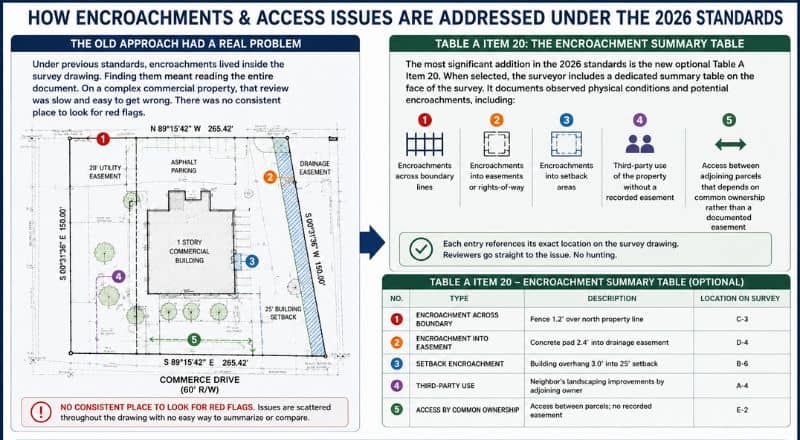
Under previous standards, encroachments lived inside the survey drawing. Finding them meant reading the entire document. On a complex commercial property, that review was slow and easy to get wrong. There was no consistent place to look for red flags.
Table A Item 20: The Encroachment Summary Table
The most significant addition in the 2026 standards is the new optional Table A Item 20. When selected, the surveyor includes a dedicated summary table on the face of the survey. It documents observed physical conditions and potential encroachments, including:
- Encroachments across boundary lines
- Encroachments into easements or rights-of-way
- Encroachments into setback areas
- Third-party use of the property without a recorded easement
- Access between adjoining parcels that depends on common ownership rather than a documented easement
Each entry references its exact location on the survey drawing. Reviewers go straight to the issue. No hunting.
What the Table Does and Doesn’t Do
The table documents physical conditions. It does not express legal opinions or make any determination about ownership. That’s the job of title counsel.
Worth noting: many experienced surveyors had already been including a version of this summary before the 2026 standards took effect. The new requirements formalize the practice and make it consistent across firms.
Changes to Table A Items and Optional Survey Responsibilities
Table A is where buyers, lenders, and developers expand what a survey covers beyond the minimum requirements. The 2026 standards added one new item, renumbered one existing item, and clarified several others.
Item 20 Is New. Item 21 Is the Old Write-In.
The 2021 Table A had 19 numbered items, plus a blank Item 20 for custom additions. That blank has been replaced by the encroachment summary. The write-in option still exists. It’s now Item 21.
Item 20 is already showing up as a standard requirement from most commercial lenders. For complex properties with shared access, tight setbacks, or complicated boundary histories, selecting it adds real value to the survey deliverable.
Other Table A Changes Worth Knowing
Item 11(b) – Private Utility Locates Clients can now coordinate private utility location requests directly instead of routing everything through the surveyor. Useful on properties with layered or underground utility infrastructure.
Item 15 – Remote Sensing and Aerial Methods This item covers survey methods beyond traditional ground-based fieldwork, including photogrammetric mapping, remote sensing, and airborne or mobile laser scanning. Under the 2026 version, the surveyor must confirm with the client that these methods are acceptable before using them. Clients have to agree before traditional field observation gets replaced with remote data collection.
Table A Introduction The introduction now states that some Table A items listed as optional may actually be required by state statute, administrative rule, or local ordinance. Check local requirements. Don’t assume any item is discretionary.
Negotiated Items Any Table A item that was modified or negotiated between the surveyor and client must be explained in the survey. Vague agreements about scope don’t hold up under the 2026 standards.
What Property Owners, Buyers, and Lenders Should Do Differently in 2026
The transaction process itself doesn’t change. But several habits do.
1. Use the Right Version Language From Day One
Put “2026 ALTA/NSPS LAND TITLE SURVEY” in every survey request and engagement letter. Using outdated version language in a contract signed after February 23, 2026 creates a compliance problem that can stall closing.
2. Send the Title Commitment to the Surveyor Early
ALTA surveys are built around the title commitment. When that document is late, the survey is late. Order both at the same time. Don’t wait for the title commitment to be finalized before contacting the surveyor. Under the 2026 standards, it’s a required input, not a nice-to-have.
3. Agree on Table A Before Fieldwork Starts
Review Table A with your surveyor and lender before anyone goes to the site. Gather property documents upfront. Changes after fieldwork cost more time and money. In a tight transaction timeline, a week’s delay can create real problems.
4. Select Item 20 on Every Commercial Deal
For buyers and lenders, this item should be on every commercial acquisition or financing. It puts encroachment and access issues in one readable place. That means faster due diligence and clearer identification of anything that might need a title endorsement, easement documentation, a zoning review, or a price adjustment.
5. Build the New Detail Into Your Timeline
Surveys under the 2026 standards include more explanatory notes, more explicit easement accounting, and more back-and-forth between the surveyor and the title company. That’s by design. A more documented survey means fewer surprises at closing. But it also means the survey process needs more lead time than it used to.
Coordinate early across all parties: surveyor, title company, lender, and legal counsel. The 2026 standards work best when everyone is aligned before fieldwork begins, not after problems show up.
