Understanding the 2026 ALTA/NSPS Survey Standards
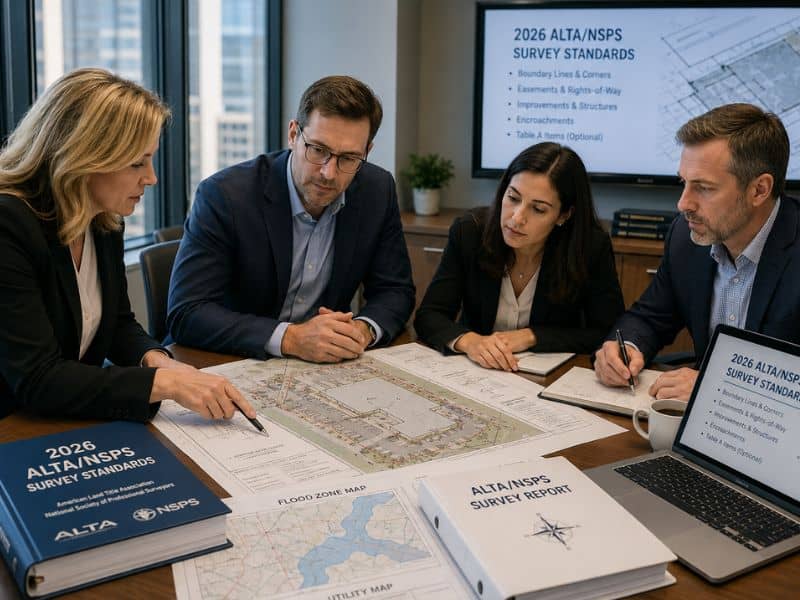
An ALTA/NSPS land title survey is a standardized property survey required for most commercial real estate closings. It maps boundary lines, structures, easements, and encroachments. A licensed surveyor must certify it under the joint standards of the American Land Title Association (ALTA) and the National Society of Professional Surveyors (NSPS). The 2026 edition is the most recent update to rules that have shaped U.S. commercial real estate deals for decades.
What Are the 2026 ALTA/NSPS Survey Standards?
The 2026 ALTA/NSPS Survey Standards set the national minimum requirements for land title surveys used in U.S. commercial real estate transactions. ALTA and NSPS publish them together, and the 2026 edition replaces the 2021 version.
ALTA and NSPS revise the standards on a regular cycle to keep surveys accurate, consistent, and legally sound in every U.S. state. The 2026 update rewrites the surveyor’s certification in clearer legal language, tightens the definitions for Table A optional items, and draws a sharper line between what’s required and what’s optional. That last change is worth noting: less gray area means fewer disagreements after the survey is done.
What every compliant ALTA/NSPS survey must include
• A precise legal description of the property boundaries
• Location of all improvements, structures, and easements
• Evidence of encroachments or rights-of-way
• Optional Table A items selected by the client
• A certification signed and sealed by a licensed surveyor
A basic boundary survey won’t satisfy most commercial lenders or title companies. ALTA/NSPS is the only survey standard that’s nationally recognized and enforceable across all 50 states.
Why Do Lenders and Title Companies Require an ALTA/NSPS Survey?
Lenders and title companies require ALTA/NSPS surveys because they answer four questions before closing: Where are the boundaries? What’s on the property? What restrictions apply? Who else has rights to it? No other survey format answers all four in a nationally consistent, legally enforceable way.
Each party at the closing table needs the survey for a different reason. Lenders require it as a loan condition. It confirms the property securing the loan is what the borrower says it is. Title companies use it to issue extended coverage policies and remove exceptions a basic title search can’t resolve. Buyers use it to verify exactly what they’re getting before money changes hands.
Skip the survey, or use one that doesn’t meet the standard, and a commercial closing can fall apart. Some don’t get back on track.
Who Relies on ALTA/NSPS Surveys?
Six groups rely on ALTA/NSPS surveys in commercial transactions: buyers and investors, lenders, title companies, real estate attorneys, developers, and architects. Each one is looking for something different in the same document.
Lenders, title companies, and buyers each have dedicated articles in this series covering their specific needs. Two groups that don’t get as much attention:
Real estate attorneys
Attorneys use the survey to check legal descriptions, confirm recorded easements, and catch anything that needs fixing before closing. A certified ALTA/NSPS survey is a legal document. If a boundary or easement dispute goes to court, it holds up.
Developers and architects
Before any construction starts, developers need exact property limits: setbacks, utility locations, and anything that restricts where they can build. The ALTA/NSPS survey has to come first. No design work or permits can move forward without it.
What Are the Key Components of an ALTA/NSPS Survey?
Every ALTA/NSPS survey starts with a mandatory baseline of seven elements. On top of that, clients can request from a list of 19 optional Table A items to fit the specific needs of their transaction.
Mandatory baseline elements (required in every survey)
• Boundary lines and corners of the property
• Location of all buildings and structures
• Visible evidence of easements and rights-of-way
• Identification of recorded documents affecting the property
• Evidence of access to a public road or right-of-way
• Observed encroachments
• A signed and sealed surveyor’s certificate
Optional Table A items (selected by the client)
Table A has 21 optional items covering things like flood zone classifications, zoning data, parking counts, and utility infrastructure. Your attorney, lender, and title company will decide which ones apply. The 2026 update gives each Table A item a clearer definition, so there’s less room for disagreement over what was ordered versus what got delivered.
How to Prepare for an ALTA/NSPS Survey Under the 2026 Standards
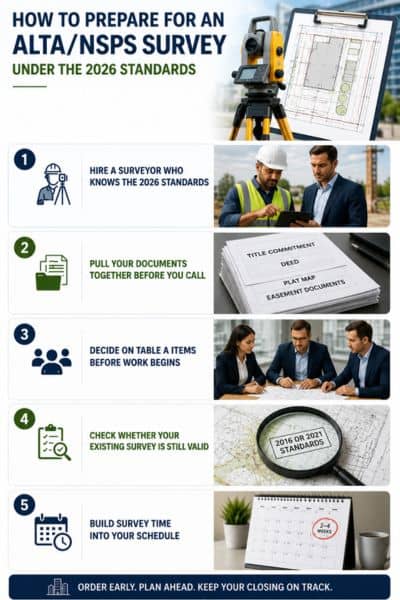
Preparing for an ALTA/NSPS survey comes down to five steps: hire a surveyor who knows the 2026 standards, gather your title and deed documents before you call, confirm Table A items with your team before work starts, check whether an existing survey is still valid, and order early. Most commercial ALTA surveys take two to four weeks.
Step 1 — Hire a surveyor who knows the 2026 standards
Not every licensed surveyor does ALTA/NSPS work. Ask directly whether they know the 2026 update. Commercial surveying takes specific experience. The wrong hire means rework, which means closing delays.
Step 2 — Pull your documents together before you call
Hand your surveyor the current title commitment, deed, and any recorded plats or easement documents. The more complete your package, the faster the survey gets done.
Step 3 — Decide on Table A items before work begins
Get your attorney, lender, and title company to agree on which Table A items are needed before the surveyor starts. Adding items after the work is underway costs more and slows everything down.
Step 4 — Check whether your existing survey is still valid
A survey done under the 2016 or 2021 standards may not pass under 2026 rules. Confirm with your title company before assuming it qualifies. An updated survey is a known cost. A failed closing is not.
Step 5 — Build survey time into your schedule
Most commercial ALTA surveys take two to four weeks. Large or complex sites take longer. Cost typically runs $2,000 to $8,000 or more, depending on acreage and complexity. Ordering early is the easiest way to keep a closing on track.
Frequently Asked Questions About ALTA/NSPS Surveys
How long does an ALTA/NSPS survey take?
Most commercial ALTA/NSPS surveys take two to four weeks. Multi-parcel sites or properties with complex easement networks can take longer. Order as early as possible in the transaction timeline.
What is the difference between a boundary survey and an ALTA/NSPS survey?
A boundary survey marks property lines. It doesn’t cover easements, encroachments, improvements, or the other details lenders and title companies require. An ALTA/NSPS survey covers all of it in a nationally standardized format. For a full comparison, see our dedicated article on what ALTA reveals that standard surveys miss.
Does my existing survey still meet the 2026 standards?
A survey done under the 2021 or earlier standards may not satisfy your lender or title company under 2026 rules. Confirm with your title company before assuming it qualifies.
Who pays for the ALTA/NSPS survey?
In most commercial deals, the buyer pays. That said, it’s negotiable and varies by market. Lenders may require it as a loan condition regardless of who funds it.
